
The Dangers of Low Cholesterol
Did you realize that there are just as many deaths from having low cholesterol as from having high cholesterol?
In particular, cancers and immune problems can occur when your cholesterol is too low. Yet you don't hear many people talking about the danger of having low cholesterol.
I had a 79-year-old man recently tell me that five years ago his cholesterol was 120 (normal is 180 to 200). His doctor then put him on a statin drug to lower it even more. After three years, it went to 110. This doctor then told him to continue taking the drug until his cholesterol reached 100. I told the man to get a new doctor-this was ridiculous!
Presently, researchers are doing studies on taking more medication to reach ultra-low cholesterol levels. There has been one little side effect, however: when people reached these ultra-low cholesterol levels, death rates increased.
Specifics on Relative Risk Factors
In looking at your risk factors with cholesterol levels, you will see that they are assessed in levels of risk and not according to the rate of contracting heart disease.
The interpreted study results (data by Drs. Stamler and Kannel, interpreters of the study that is used to support the risk factors you see when they analyze cholesterol) state that among people who have low cholesterol, one out of a thousand will die of heart disease, whereas two out of a thousand with high cholesterol will die of heart disease.
Of course, based on these study results, they would tell you that a person with high cholesterol would have a 100 percent increased risk of getting heart disease. After all, going from 1/1,000 to 2/1,000 is a 100 percent increase, right?
Not quite!
While the increase from one to two (heart deaths) would definitely be a 100 percent increase, what has been ignored is that these are fractions and they have disregarded the denominator.
If you calculate the entire FRACTION from 1/1,000 to 2/1,000, you get a slightly different picture. Going from 1/1,000 to 2/1,000 as a fraction is not a 100 percent increase but only a 0.1 percent increase (that's only 1/10 of 1 percent).
Where high cholesterol is concerned, the miniscule RATE increase of 0.1 percent now becomes a gigantic 240 percent increase in RISK.
Legally, of course, they can't say the "rate of getting heart disease," but they apparently can say the "risk of getting heart disease." The word risk has no mathematical meaning in the sciences. It doesn't mean chances. So, with this in mind, below is the actual data for those who want the figures (taken from the MRFIT data).*
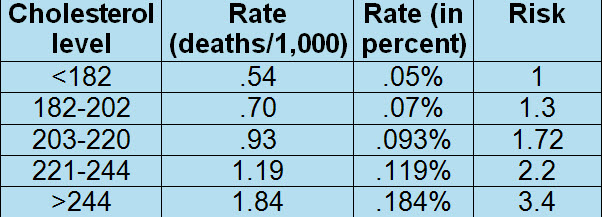
* The Multiple Risk Factor Intervention Trial (MRFIT) sought to evaluate the effect of multiple risk factor intervention on mortality from coronary heart disease in high risk men. My question is, who is benefiting from this little alteration of the facts? And, more importantly, who is suffering from it? If I told you "The probability that high cholesterol will increase your rate of getting heart disease is less than 1 percent," you wouldn't be concerned. To concern you, I would have to alter the numbers and then refer to your risk of getting heart disease.
So let's first define those terms. RISK: exposure to loss or harm. RATE: the amount or number of one thing in relation to a certain amount or number of something else. RELATIVE: regarded in relation to something else; comparative.
The truth is that if you have high cholesterol, your actual rate of getting heart disease is only 1/4 of 1 percent. Here are some additional facts on these relationships. At least 33 cholesterol-lowering trials were performed during the last 40 years and the National Heart, Lung and Blood Institute (NHLBI) is planning another $60-million, seven-year trial. This need to conduct so many trials should prompt the question, If the cholesterol/heart disease theory is so strong, why are so many trials needed to support it? Dr. Robert Levy, director of the NHLBI, stated before the 1977 Senate Select Committee on Nutrition and Human Needs: "The problem with all these trials is that none of them have shown a difference in heart attack or death rate in treated groups."
Dr. Basil Rifkind, also of the NHLBI, emphasized in 1979, "To date, no study has actually shown that lowering cholesterol is of benefit in preventing heart attacks."
Of the twelve cholesterol-lowering drug trials showed greater numbers of deaths in the treatment groups than in the control groups.
Does Cholesterol Have a Purpose?
Cholesterol makes hormones. It also lines the nervous system and allows electrical flows. Cholesterol heals damaged tissues. It feeds the eyes, particularly the lens of the eye, which has no direct blood supply, so it can only grow via cholesterol-rich cells. Because of this, anything that interferes with cholesterol metabolism (e.g., anti-cholesterol drugs) has the potential to cause cataracts.
Other side effects of cholesterol-lowering drugs include the following:
In sum, I'm not saying you should be happy with high cholesterol. The point is to get your cholesterol within the normal range-not excessively low or high.